“While systems do mimic their organisations’ structure, changing the organisation doesn’t seem to have the same effect. That’s because we’re not accounting for the properties of the system under design itself.” https://verraes.net/2022/05/conways-law-vs-rigid-designs/
“To counter this trap, we need to stop pretending like we’re not placing bets. That’s what a “plan” is, after all, a collection of bets laid out as a chain of prespecified options.”
Monty Hall, Storytelling, and Planning – Charles Lambdin https://charleslambdin.com/2022/05/18/monty-hall-storytelling-and-planning/
“Designing fit-for-purpose team processes takes more focus, thought and, initially, time than simply implementing a one size fits all framework.”
The age of Scrum is over. Scrum has given us a lot, but its time… | by Chris Lennon | Medium https://chrisjameslennon.medium.com/the-age-of-scrum-is-over-185407ad705b
“A challenge I’ve encountered is that it is easy to confuse jumping headlong into the mess with analysis paralysis. Or “not bringing solutions”. Or “being unrealistic”. Or “you’re making this too complicated!” Why?”
https://cutlefish.substack.com/p/tbm-2054-youre-making-this-too-complicated
WDYT about
1. Tweet a day for a week explaining why the opponent/city deserved to win.
2. Or, seven tweet thread equivalent
3. Avatar update with opposing teams cap for a week?
Yes. People have made (hopefully reversible) decisions based on the expectation. What macroeconomic (vs market specific) conditions have changed in the past two weeks?
And if they are _that_ volatile, then that’s also an informative future-looking datapoint.
That’s not going to cover visa issues, deferred education enrollments, relocations/lease terminations, or health care (ack - applies to early BIS as well).
I acknowledge they can, and perhaps it even makes sense they do so.
1. How will we know it’s doing what we expect?
2. How will we know it’s doing something we didn’t expect?
3. How will we know it’s not doing something we expect?
4. How will we know it’s not doing something we didn’t expect?
“[W]e can gain insight into how incidents happen, even those that involve operator actions as contributing factors, without reference to human error at all.”
Imagine there’s no human error… – Surfing Complexity https://surfingcomplexity.blog/2022/05/30/imagine-theres-no-human-error/
“One of my coaching clients and I developed this framework to help him think about the kind of impact he wanted to have as a Staff+ engineer…” https://cate.blog/2022/06/06/dimensions-of-engineering-growth/
4. Elevate the system’s constraint
5. If in the previous steps, a constraint has been broken, go back to step 1. Do not allow inertia to cause a system constraint.
* Local operational maxima may be global system minima
* Bottlenecks are everywhere and they move around
* Make work (and pending work, inventory) visible
* Variability is intrinsic, but not insurmountable
* Full utilization is unattainable
“Our approach accurately predicts the deployment performance of large-scale microservice applications in various configurations from a single execution trace.”
“We have validated μqSim both against simple and more complex microservices graphs, and have shown that it accurately captures performance in terms of throughput and tail latency.”
“As a leader, one of your most important jobs is to uncover these strengths and weaknesses and use that knowledge to drive productivity and engagement. Consider five ways to do so.” https://www.thebalancesmb.com/effectively-determine-employee-strengths-2951397
“This myth is a misguided belief that engineers are like Laplace’s Demon; they maintain an accurate mental model of the system, foresee all the consequences of their actions, predict where the business is going, and are careful enough to avoid mistakes.”
Whether it’s serverless, ML pipelines, k8s, unikernels, or printer drivers, a team’s ability to safely, predictably, and rapidly deploy changes is critical to produce better outcomes and learn faster.
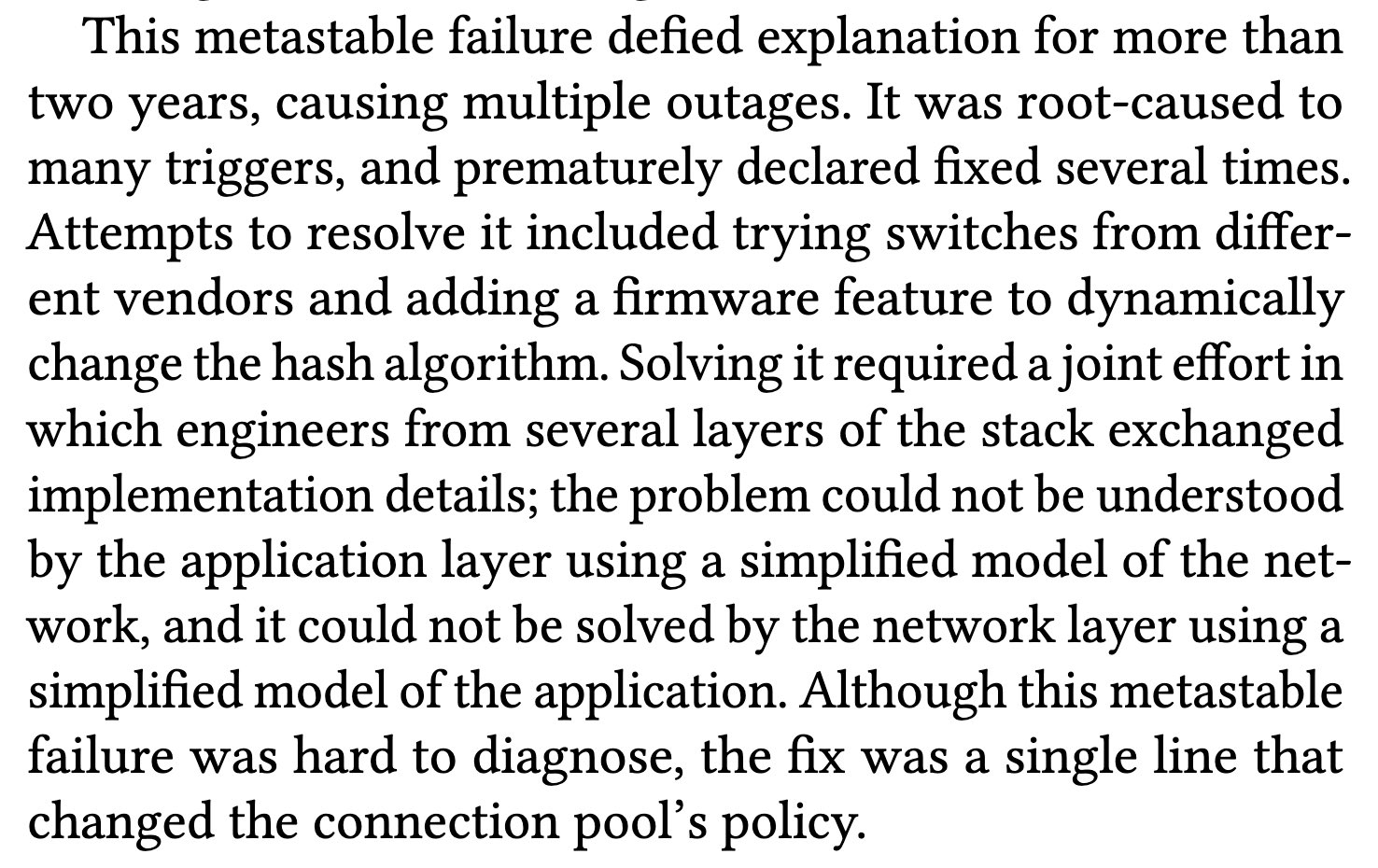
“A key property of metastable failures is that their root cause is not a specific hardware failure or a software bug. It is an emergent behavior of a system, and it naturally arises from the optimizations for the common case..” https://www.usenix.org/publications/loginonline/metastable-failures-wild
“Metastable failures are a class of failures that impact dis-
tributed systems…They are an emergent behavior rather than a logic bug—one cannot write a unit or integration test to trigger them. “